

One might suggest that every writer, pastor, teacher, coach, consultant, and creator ought to develop a personal AI policy.
Not merely because platforms require it.
Not merely because readers may ask.
Not merely because editors, algorithms, or detection tools are watching.
But because integrity matters.
Creativity can go stale when we stop doing the hard work of thinking, wrestling, shaping, doubting, revising, and deciding. AI can help with that work. It can also quietly replace it if we let it.
Medium’s current AI policy makes a useful distinction. Medium says it is “for human storytelling, not AI generated writing,” and defines AI-generated writing as work where the majority of the content has been created by an AI-writing program with little or no human editing, improvement, fact-checking, or change. Medium also distinguishes that from AI-assistive tools such as outlining, spelling, grammar, and fact-checking help.
That distinction matters to me.
Because I do use AI.
But I do not want AI to use me.
I want AI to supplement the creative process, not substitute for the creative process.
Those are my words, and I quote myself exactly.
Or, as Mrs. Slocombe used to say on the old British comedy Are You Being Served?: “That’s my opinion, and I’m unanimous in it.”
My Premise
My work should remain:
My ideas.
My words.
My flow.
My personality.
My voice.
Helped by an assistant.
That is the point.
There was a time when I had human assistants, back when someone else was paying for them. A good assistant could help organize notes, catch mistakes, remind me of context, prepare drafts, and ask clarifying questions.
Now, for less than $25 a month, I can use an electronic assistant.
That does not make the assistant the author.
It makes the assistant an assistant.
Sandeep Swadia, known as theMITmonk, makes a similar point from another angle. In his video, he describes using ChatGPT not as a novelty or a toy, but as a system: a “clone,” a “swarm,” a “devil’s advocate,” a “neural link,” and an “executive coach.” His premise is that ChatGPT becomes more useful when it is trained with context, used for research and critique, and asked to challenge rather than merely flatter the user.
That is close to what I am trying to do.
But as a writer, preacher, teacher, and coach, I need to add a layer:
What is my policy?
Not Medium’s policy only.
Not Substack’s policy only.
Not YouTube’s, LinkedIn’s, or anyone else’s.
Mine.
Why Writers Need Their Own AI Policy
Platform policies are necessary, but they are not sufficient.
Medium says AI-generated writing is not allowed behind the paywall as part of the Partner Program, and undisclosed AI-generated writing may be limited to network-only distribution. Medium also requires disclosure when a story incorporates AI-generated text or AI-generated images.
That is useful guidance.
But platform compliance is a low bar.
A personal AI policy asks deeper questions:
Am I still thinking?
Am I still creating?
Am I still responsible for what I publish?
Am I using AI to clarify my voice or to hide the absence of one?
Am I becoming sharper, or am I outsourcing judgment?
Medium’s paywall guidance also notes that “fully AI-generated writing” is not eligible for the paywall when the majority of the content has been generated by an AI tool with little or no human editing, fact-checking, or original contribution.
That phrase — original contribution — is where the real issue lives.
The question is not simply, “Did AI touch this?”
The better question is, “Where is the human contribution?”
My Working AI Policy
Here is my working policy:
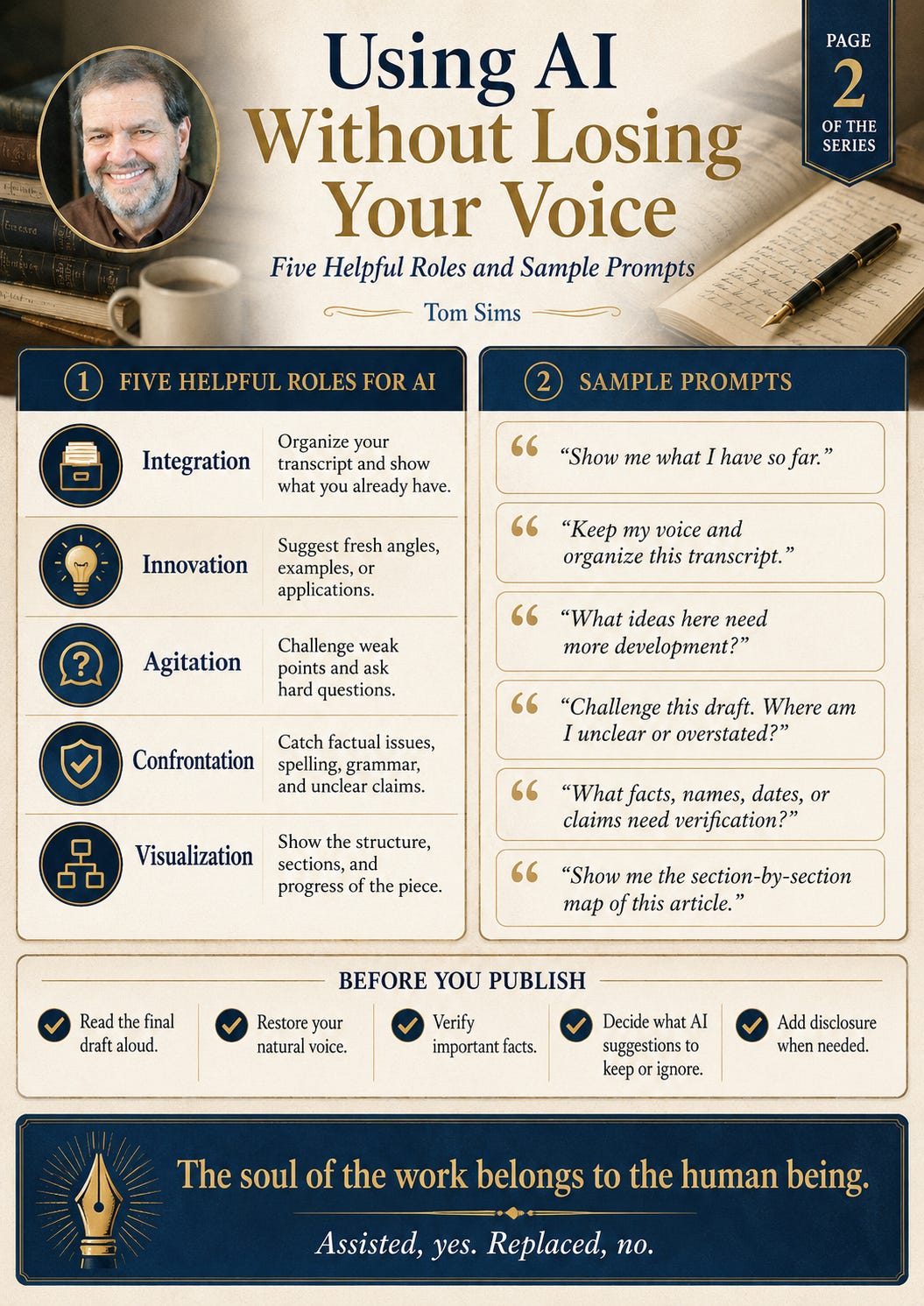
AI may assist me in organizing, sharpening, questioning, testing, formatting, researching, and visualizing my material. AI may not replace my core thinking, voice, convictions, judgment, or responsibility.
That means I can use AI as:
an organizer,
a proofreader,
a challenger,
a coach,
a research assistant,
a summarizer of my own material,
a formatter,
a visual brainstorming partner.
But I should not use AI as:
a ghostwriter pretending to be me,
a substitute for reading,
a substitute for reflection,
a shortcut around attribution,
a filler machine,
a way of producing volume without soul,
a device for passing off borrowed thought as original insight.
Then:
Beyond the wall: practical tools for developing your own AI integrity policy, including a disclosure template, a writer’s checklist, and sample prompts for using AI without surrendering your voice.


