

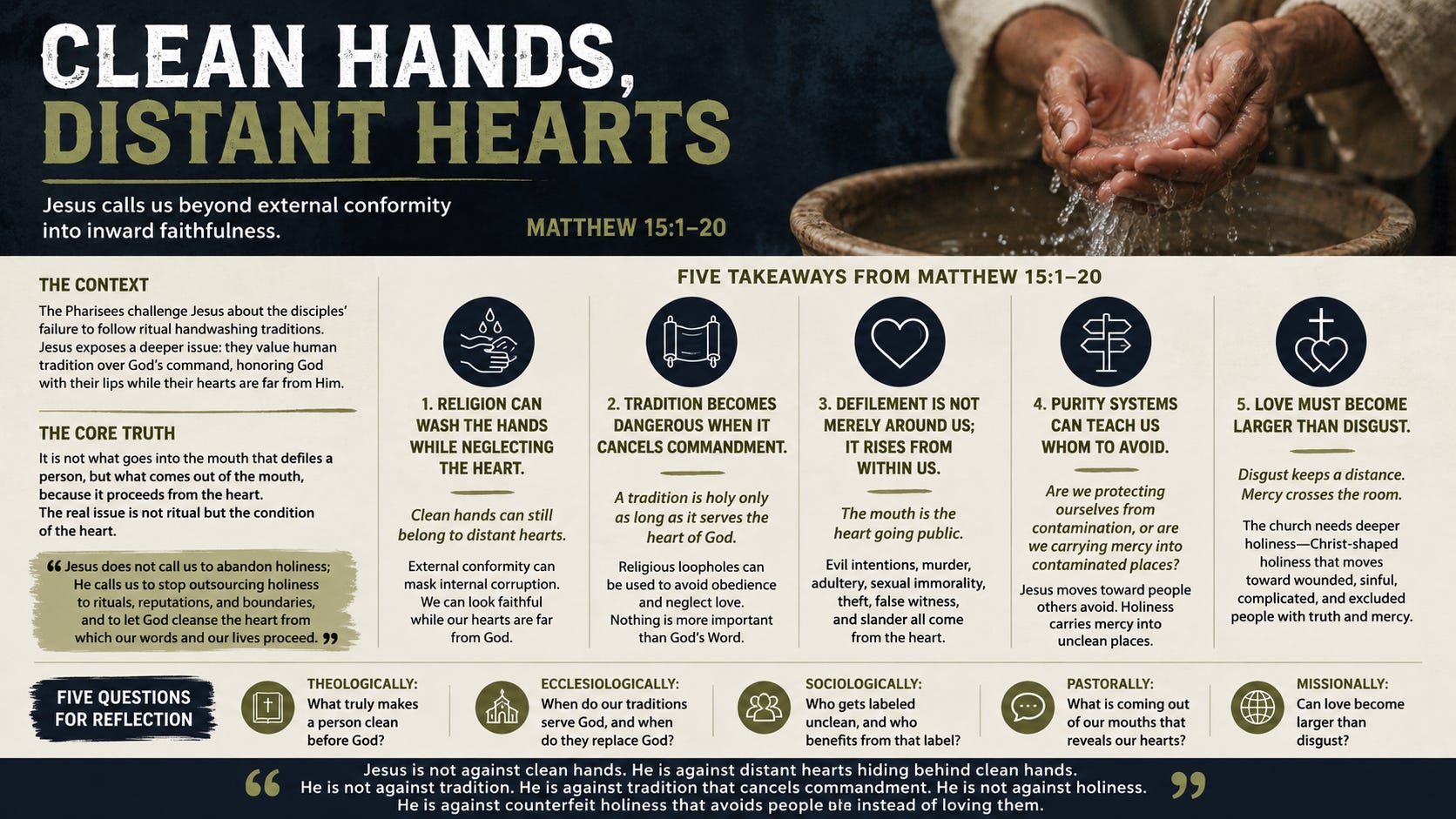
We come today to Matthew 15, and the Pharisees are still trying to trap Jesus.
They come to him with a question:
“Why do your disciples break the tradition of the elders? For they do not wash their hands before they eat.”
It is important to understand what kind of handwashing they mean.
This is not mainly sanitary handwashing. This is not about germs. This is not about washing up before supper the way your mother taught you to do.
This is ritual handwashing. Ceremonial handwashing. Religious handwashing.
The issue is not hygiene. The issue is purity. The issue is tradition. The issue is whether the disciples of Jesus are living according to the accepted religious expectations of the elders.
The Pharisees ask Jesus:
“Why do your disciples break the tradition of the elders?”
But Jesus turns the question back on them:
“And why do you break the commandment of God for the sake of your tradition?”
That is the real issue in this passage.
They are talking about the tradition of the elders. Jesus is talking about the commandment of God.
They are concerned about what touches the hands. Jesus is concerned about what rises from the heart.
They are concerned about external conformity. Jesus is concerned about inward faithfulness.
And Jesus gives them an example.
God said:
“Honor your father and your mother.”
But they had developed a religious loophole. A person could say that the support his parents might have received from him had been given to God. It was devoted. It was set aside. It was religious.
But in practice, that religious language could become an excuse to avoid caring for one’s parents.
And Jesus says:
“For the sake of your tradition, you nullify the word of God.”
That is a serious charge.
Tradition is not automatically bad. Jesus is not saying tradition has no value. Traditions can remind us who we are. Traditions can shape us. Traditions can carry memory. Traditions can give structure to worship and life.
But tradition becomes dangerous when it cancels commandment.
Tradition becomes dangerous when it helps us avoid obedience.
Tradition becomes dangerous when it lets us sound religious while neglecting mercy.
Tradition becomes dangerous when it protects our comfort more than it serves the heart of God.
Jesus quotes Isaiah:
“This people honors me with their lips,
but their hearts are far from me;
in vain do they worship me,
teaching human precepts as doctrines.”
That is the problem.
Their lips are close.
Their rituals are close.
Their religious language is close.
Their public appearance is close.
But their hearts are far away.
That is why this reflection is called:
Clean Hands, Distant Hearts.
Because clean hands can still belong to distant hearts.
And that is not just a Pharisee problem.
That is a human problem.
That is a church problem.
That is our problem.
We can sing the hymns, speak the words, pray the prayers, quote the verses, attend the services, defend the traditions, and still harbor resentment, contempt, greed, slander, prejudice, fear, indifference, or bitterness.
We can appear faithful while our hearts drift far from God.
We can look clean and still be unclean where it matters most.
Jesus then calls the crowd to him and says:
“Listen and understand: it is not what goes into the mouth that defiles a person, but it is what comes out of the mouth that defiles.”
That is the turning point.
Jesus moves the conversation from the hands to the heart.
He is saying, “You are worried about what goes in. I am telling you to pay attention to what comes out.”
The disciples are troubled by this. They come to Jesus and say, in effect:
“Do you know that the Pharisees were offended when they heard what you said?”
Jesus knows.
And he says:
“Every plant that my heavenly Father has not planted will be uprooted. Let them alone; they are blind guides of the blind. And if one blind person guides another, both will fall into a pit.”
That is strong language.
Jesus is not being careless. He is not being cruel. But he is refusing to let offended religious leaders control the mission of God.
There are times when truth exposes what is false. There are times when the word of God uproots what God did not plant. There are times when leaders who claim to guide others are themselves blind.
And Jesus says, “Let them alone.”
In other words, do not build your life around keeping false religion comfortable.
Do not let offended tradition keep you from obeying God.
Do not follow blind guides into the ditch.
Peter still does not understand, so he asks Jesus to explain.
Jesus says:
“Do you not see that whatever goes into the mouth enters the stomach and goes out into the sewer? But what comes out of the mouth proceeds from the heart, and this is what defiles.”
Jesus is direct.
Food enters the body and passes through.
But words, motives, actions, and intentions come from the heart.
Then Jesus gives the list:
“For out of the heart come evil intentions, murder, adultery, sexual immorality, theft, false witness, slander.”
These are not small things. These are sins with victims. These are sins that damage people, betray people, use people, lie about people, wound people, and destroy community.
Jesus is saying that true defilement is not merely around us.
It rises from within us.
That forces a different kind of examination.
We often ask, “Who is dangerous to me?”
Jesus asks, “What is coming out of me?”
We ask, “Who might contaminate us?”
Jesus asks, “What is proceeding from your heart?”
We ask, “Who is unclean?”
Jesus asks, “What do your words reveal about you?”
The mouth is the heart going public.
What we say is not accidental. It reveals something. Our words reveal what we love, what we fear, what we resent, what we worship, and what we have not surrendered to God.
Clean hands can still belong to distant hearts.
That is the first takeaway.
Religion can wash the hands while neglecting the heart.
The Pharisees are asking why the disciples do not follow the ritual traditions of the elders. Jesus exposes a deeper problem. They have allowed tradition to become a way to measure righteousness while avoiding actual obedience.
That can happen anywhere.
It can happen in a liturgical church.
It can happen in a free church.
It can happen in a conservative church.
It can happen in a progressive church.
It can happen in an old church.
It can happen in a new church.
It can happen in my heart.
It can happen in yours.
Any time we learn how to look faithful without being faithful, we are in danger.
Any time we learn how to sound holy without being loving, we are in danger.
Any time we use religious language to cover an unconverted attitude, we are in danger.
Clean hands can still belong to distant hearts.
Tradition becomes dangerous when it cancels commandment.
Jesus uses the example of Corban. Something that sounded like devotion to God had become an excuse to neglect love of family.
That is the scandal.
Something religious was being used to avoid something righteous.
And that still happens.
Our systems, customs, policies, slogans, habits, and unwritten rules can make it easier to avoid mercy.
We can defend morality in one area while excusing cruelty in another.
We can protect institutions while neglecting people.
We can quote Scripture while avoiding obedience.
We can preserve appearances while ignoring the wounded.
We can use the language of holiness to justify the absence of love.
But a tradition is holy only as long as it serves the heart of God.
If a tradition helps us love God and love our neighbor, it is a gift.
If a tradition helps us avoid loving God or loving our neighbor, it has become an idol.
For reflection before the paywall
What religious habits or traditions have helped keep your heart near God?
What traditions, habits, or assumptions might be tempting you to judge others rather than examine yourself?
When have you seen religious language used to avoid mercy?
What has come out of your mouth lately that may reveal something unresolved in your heart?
Are you more concerned with avoiding contamination or carrying mercy?


