

Matthew 13:1–23 in four translations: https://www.biblegateway.com/passage/?search=Matthew%2013%3A1-23&version=NRSVUE,NIV,PHILLIPS,NLT
The Word is still being sown. The question is what happens when it lands.
If you can hear this, it is because you have ears.
And Jesus says, “If you have ears — hear.”
That is not merely an invitation to listen casually. It is a call to attention, response, and decision.
The Message:
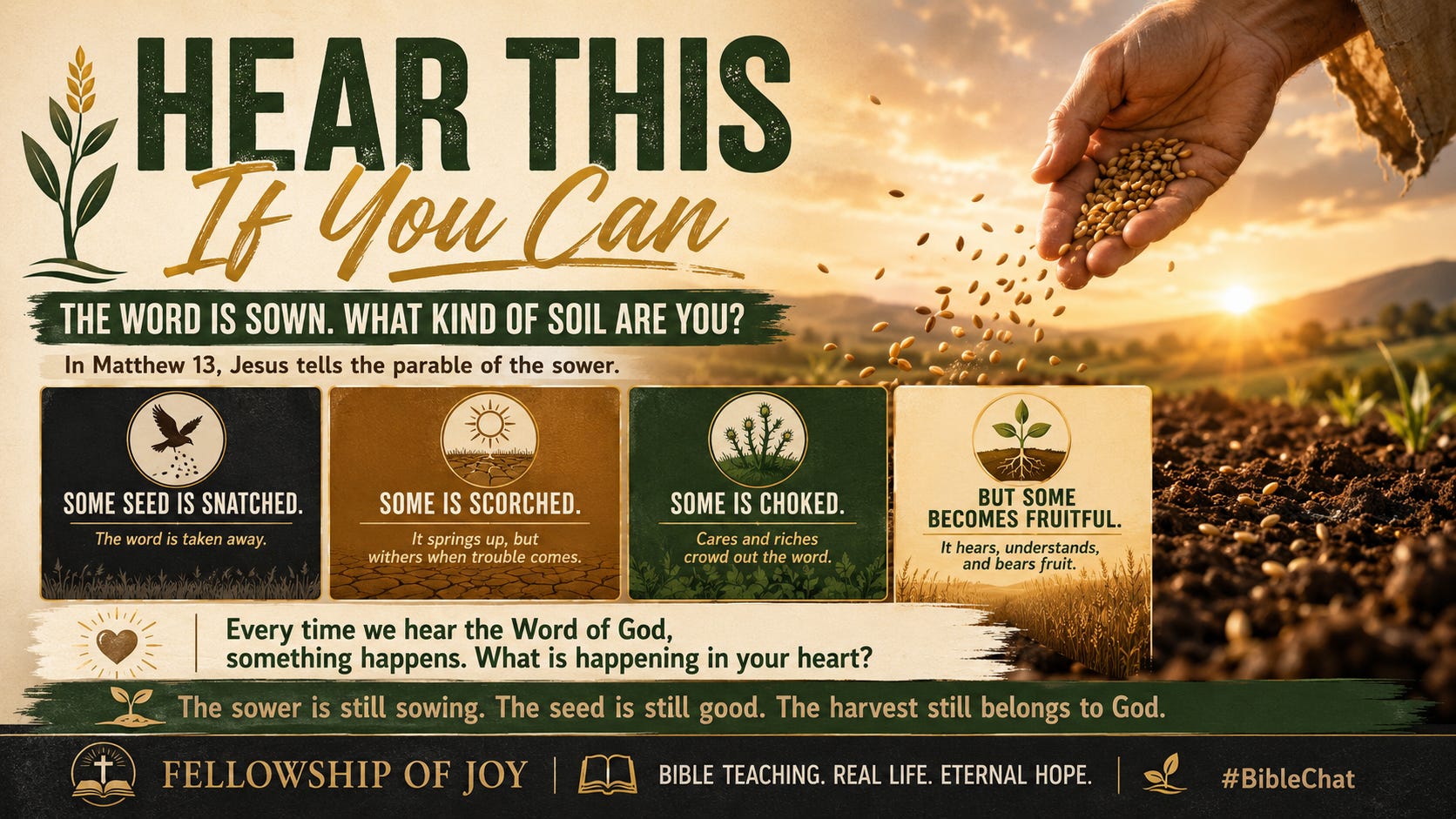
In Matthew 13, Jesus tells a story that many of us have heard before. A sower goes out to sow. Some seed falls on the path and is snatched away. Some falls on rocky ground and springs up quickly, only to be scorched by the sun. Some falls among thorns and is choked. But some falls on good soil and bears fruit — thirty, sixty, even a hundredfold.
It is familiar.
Maybe too familiar.
Sometimes the most familiar words of Jesus are the ones we are most tempted to stop hearing.
But Jesus does not let us turn this into a quaint farming illustration. He ends the parable with a challenge:
“If you have ears, hear.”
In other words:
Do not merely admire the story.
Do not merely analyze the soil.
Do not merely evaluate someone else’s response.
Hear it.
Receive it.
Let it ask something of you.
Because every hearing of the Word becomes a kingdom moment.
Will the Word be snatched?
Will it be scorched?
Will it be choked?
Or will it become fruitful?
The Kingdom Is Being Broadcast
Matthew tells us that Jesus went out of the house and sat beside the sea. The crowds gathered around Him, so He got into a boat and taught while the people stood on the beach.
This matters.
Jesus is not teaching in a quiet classroom. He is not giving a private lecture to a few religious specialists. He is speaking publicly, broadly, generously.
The kingdom is being broadcast.
The sower in the story does not place each seed delicately in a carefully measured hole. He scatters it widely. Some lands where it will not grow. Some lands where it will begin but not endure. Some lands where other things will crowd it out.
But still the sower sows.
The sower is not careless because the seed is cheap.
The sower is extravagant because the kingdom is urgent.
That is important for those of us who preach, teach, write, parent, mentor, post, share, pray, and bear witness.
We do not always know where the good soil is.
We are not always qualified to judge in advance where fruit will come.
Sometimes the person who seems least likely to respond is the one in whom the Word takes deep root. Sometimes the person who responds most quickly disappears when trouble comes. Sometimes the respectable, religious, busy person slowly allows the thorns to take over.
The sower sows anyway.
Because the seed is good.
Because the kingdom is urgent.
Because the harvest belongs to God.
The Story Sorts the Hearers
The disciples ask Jesus why He speaks in parables.
His answer is not easy. He speaks of seeing and not perceiving, hearing and not understanding. He quotes Isaiah’s painful call to speak to a people whose hearts have grown dull.
At first, it can sound as though Jesus is hiding the truth.
But that is not the heart of it.
Parables reveal and conceal at the same time.
They reveal truth to those willing to lean in.
They conceal truth from those who have already decided not to hear.
A parable is not merely a story. It is heart-language.
It gets beneath our defenses. It invites us to locate ourselves inside the story. It reveals what is happening beneath the surface.
The difference between the crowd and the disciple is not that the disciple understands everything immediately.
The disciples do not understand everything immediately.
But they come back to Jesus and ask, “What does this mean?”
That may be one of the marks of a true disciple.
A disciple keeps leaning in.
A disciple keeps asking.
A disciple keeps listening.
A disciple does not walk away because the truth comes wrapped in mystery.
Maybe that is part of what it means to have ears to hear.
The Word Meets Real Resistance
Jesus explains the parable.
The seed is the Word of the kingdom.
The soil represents the hearing heart.
And the Word meets resistance.
Some is snatched.
This is the Word that lands on the path. It does not penetrate. The heart is hard. The seed remains exposed, and the evil one snatches it away.
A heart does not usually become hard all at once. It is packed down over time — by repeated refusal, repeated postponement, repeated distraction, repeated disappointment, repeated cynicism, or repeated religious familiarity without obedience.
Some is scorched.
This is the Word received with quick joy but without root. It springs up fast, but when trouble or persecution comes, it withers.
Joy is not the problem.
Rootlessness is the problem.
Some is choked.
This is the Word that lands among thorns. It is heard, but the cares of the age and the lure of wealth crowd it out.
The thorns do not need to deny the seed.
They only need to outgrow it.
That may be the most common danger for many of us.
We may not be rejecting God outright. We may simply be full — full of worry, full of noise, full of obligation, full of ambition, full of anxiety, full of lesser things that slowly become larger than they should.
No room for prayer.
No room for repentance.
No room for silence.
No room for mission.
No room for obedience.
No room for the Word to grow.
Snatched.
Scorched.
Choked.
But then Jesus says some becomes fruitful.
The Word Still Bears Fruit
The good soil is the one who hears the Word, understands it, and bears fruit.
That is Matthew’s emphasis:
Hearing.
Understanding.
Fruit-bearing.
Fruitfulness is not sameness.
Jesus says some bear a hundredfold, some sixty, some thirty. Not every fruitful life looks the same. Not every calling is identical. Not every harvest is measured in the same way.
But where the Word is truly received, life begins to multiply.
Fruit appears.
The Word becomes visible.
Grace becomes embodied.
The seed carries life within itself, and when it is received, it produces more life.
So the sower keeps sowing.
The preacher keeps preaching.
The teacher keeps teaching.
The parent keeps praying.
The friend keeps witnessing.
The small group keeps gathering.
The servant keeps serving.
The writer keeps writing.
The church keeps scattering seed.
Not because every seed appears to succeed immediately.
But because the harvest is real.
Pentecost Hope for the Soil
I am reflecting on this in the light of Pentecost.
And Pentecost matters here.
On Pentecost, the Spirit comes. The disciples who had misunderstood, stumbled, fled, and hidden are filled with the Holy Spirit. The Word is proclaimed. People hear the mighty works of God in their own languages. Hearts are pierced. They ask, “What should we do?”
That is soil being opened.
That is the Spirit at work.
Jesus does not make soil preparation the main point of this parable. In the immediate crisis of Matthew 13, the emphasis is on scattering the seed and hearing the Word.
But in the long mission of God’s people, Pentecost gives us hope.
Hard soil can be broken open.
Shallow soil can be deepened.
Crowded soil can be cleared.
Unreceptive soil can be given another chance.
The good news is not that hard soil can try harder to become good soil.
The good news is that the Spirit of God can plow what we cannot.
So we ask:
Come, Holy Spirit.
Break up the packed-down places.
Deepen the thin places.
Clear the crowded places.
Make us hearers who understand.
Make us lives that bear fruit.
Because the sower is still sowing.
The seed is still good.
And the harvest still belongs to God.
For Reflection
Where has your heart become hard?
Where are you shallow — quick to respond, but slow to root?
Where are you crowded — not rejecting God, but allowing worry, wealth, ambition, distraction, or fear to choke the Word?
Where is the Word trying to take root in you today?
And where are you being called not only to receive the seed, but to scatter it?
Invitation
This reflection is part of the ongoing Bible Chat series — Bible teaching for real life, spiritual growth, and everyday discipleship.
You can explore more Bible Chat reflections here:
Bible Chat on Substack:
https://tomsims.substack.com/s/bible-chat
Tom Sims links and resources:
https://linktr.ee/tomsims


