

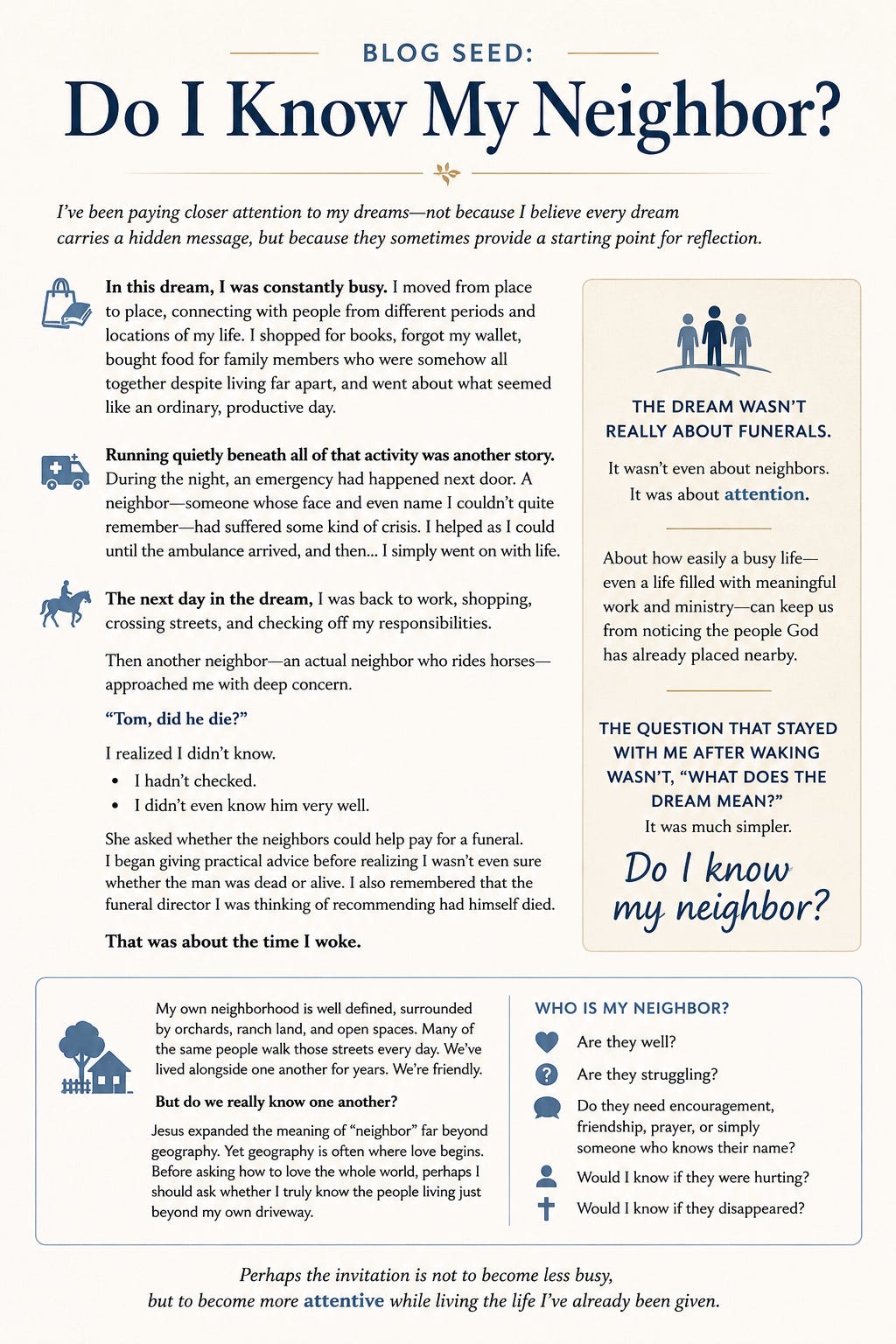
This study grows out of two earlier reflections on the same question.
The first began as a personal essay on Medium, where I described the dream that left me asking, “Do I know my neighbor?”
Read the Medium version here:
https://medium.com/@tomsims/do-i-know-my-neighbor-22cd947af36a?sk=c090a737f65bf133a237ebd39100ff8f
I then developed the question more explicitly through Luke 10 and the story of the Good Samaritan for PastorTom.blog:
https://pastortom.blog/2026/07/11/do-i-know-my-neighbor/
The Medium essay begins with attention and reflection. The PastorTom.blog version moves toward discipleship and the call to become a neighbor. This section takes the next step by offering biblical study, practical exercises, and concrete ways to respond.
Jesus never intended the Good Samaritan to become merely a familiar story. He intended it to become a way of life.
If my dream left me asking, “Do I know my neighbor?” then Scripture invites me to ask another question:
What would it look like to become a better neighbor?
Luke 10:25–37: From Definition to Transformation
Read the story slowly.
The lawyer asks:
“Who is my neighbor?”
Jesus concludes by asking:
“Which of these three proved to be a neighbor?”
Those are not quite the same question.
The first seeks a definition.
The second calls for transformation.
The lawyer wanted to know where to draw the boundary.
Jesus asked whether he was willing to cross one.
We often want to identify who qualifies for our concern. Jesus turns our attention toward the kind of person we are becoming.
As you read, consider:
Which character do I most resemble today?
What interruptions am I resisting?
What excuses do I tend to make?
What does compassion cost the Samaritan?
What risks does he take?
What would “Go and do likewise” look like this week?
The Difference Was Attention
The priest saw the wounded man.
The Levite saw him.
The Samaritan saw him.
The difference was not eyesight.
It was attention.
The Samaritan allowed what he saw to interrupt his journey.
This connects directly with the original Medium reflection. The central issue in the dream was not a lack of concern. It was that I had become busy, moved on, and failed to check.
Compassion often begins when we stop treating interruption as an enemy.
Acts 17:26–27: Is My Address Part of My Calling?
Paul tells the Athenians that God made the nations and determined the times and places in which people would live.
That raises a possibility worth considering:
Perhaps my address is more than an address. Perhaps it is an assignment.
God has placed us within overlapping neighborhoods:
The neighborhood where we live
The neighborhood where we work
The neighborhood where we worship
The neighborhood where we shop
The neighborhood where we volunteer
The digital neighborhoods where we gather online
Every one of those places contains people God loves.
Our presence there may not be accidental.


