

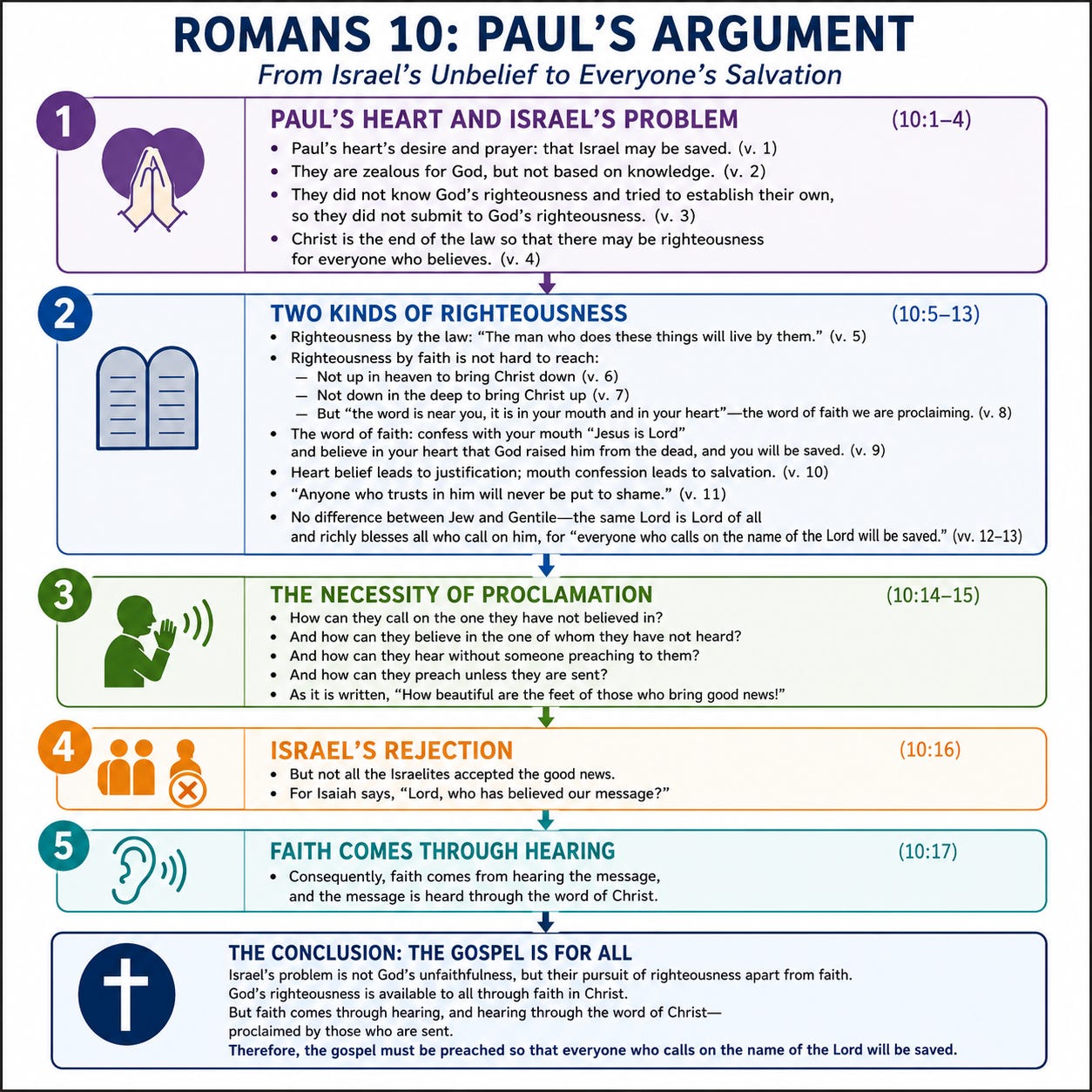
In Romans 10, the apostle Paul is building a case. He is developing an argument and taking us on a journey—from Israel’s unbelief to the declaration that salvation is available to everyone.
1. Paul’s Heart and Israel’s Problem
Romans 10:1–4
Paul begins with compassion, not condemnation.
He is not pointing an accusing finger at people. He is expressing his heart’s desire and prayer that Israel might be saved.
Paul was a Jew—an Israelite. He was steeped in the law and in the traditions of the elders. He loved Israel, understood its traditions, and valued the law. He also understood zeal. In fact, Paul had once been the poster child for religious zeal.
But Paul says that it is possible to possess zeal for God without that zeal being grounded in true knowledge.
The people he loves do not understand that true righteousness is not something we muster, manufacture, or establish for ourselves. Righteousness comes from God.
Whenever we attempt to establish a righteousness of our own, we fail. In our self-righteousness, we refuse to submit to the righteousness God provides.
Paul then states his central conviction:
Christ is the culmination, goal, and fulfillment of the law, so that righteousness may be available to everyone who believes.
The progression is:
Zeal without knowledge
→ self-established righteousness
→ failure to submit to God’s righteousness
→ Christ as the fulfillment of the law
2. Two Kinds of Righteousness
Romans 10:5–13
In the second movement, Paul contrasts two approaches to righteousness:
Righteousness based on the law.
Righteousness received through faith.
God’s righteousness is offered by grace and received through faith.
Paul quotes Moses:
“The man who does these things will live by them.”
That statement is true. The righteousness described by the law depends upon doing and achieving.
The problem arises when we expect our actions to produce righteousness rather than demonstrate a righteousness we have received from God.
Paul then describes righteousness by faith.
This kind of righteousness does not require an impossible spiritual journey.
No one needs to ascend into heaven to bring Christ down.
No one needs to descend into the depths to bring Christ up from the dead.
God has already acted through the incarnation, death, and resurrection of Jesus Christ.
God has done the heavy lifting.
We do not have to climb a ladder to reach God. We do not have to dig into the depths to find Christ. God has brought the message near to us.
Paul says:
“The word is near you; it is in your mouth and in your heart.”
The word is present in the message of faith being proclaimed. Therefore, our response is accessible.
Paul makes it remarkably simple:
Confess with your mouth, “Jesus is Lord.”
Believe in your heart that God raised him from the dead.
You will be saved.
To say that Jesus is Lord is to confess that he is King, ruler, sovereign, and the one to whom we give our allegiance.
To believe that God raised Jesus from the dead is to place our trust in God’s decisive and magnificent act of resurrection.
Paul explains:
The heart believes and receives righteousness.
The mouth confesses and openly identifies with salvation.
We will spend the rest of our lives exploring what it means to believe. What is saving faith? What does it mean to trust God while we still have questions and doubts?
Those are important conversations. But here Paul puts it simply: believe enough to receive.
Confession is an act of commitment. When we say something openly, we identify ourselves with it. We declare it to be real and true.
Paul then quotes Scripture:
“Anyone who trusts in him will never be put to shame.”
Notice the word anyone.
The promise is universal.
There is no distinction between Jew and Gentile in the matter of salvation, trust, God’s love, or God’s desire to save.
The same Lord is Lord of all.
Throughout history, people have worshiped tribal gods, regional gods, and national gods. Even today, nationalism can tempt people to imagine that God belongs more to their nation than to someone else’s.
But Paul declares that there is one Lord—the Lord of all.
God richly blesses all who call upon him:
“Everyone who calls on the name of the Lord will be saved.”
The name of the Lord represents the character, reality, authority, and presence of God. Scripture uses many names and titles for God—Yahweh, Elohim, Adonai, Lord, and Christ. No single word in human language contains or fully describes God.
The progression is:
God’s saving work in Christ
→ the word brought near
→ belief in the heart
→ confession with the mouth
→ salvation
→ inclusion of everyone who calls upon the Lord
3. The Necessity of Proclamation
Romans 10:14–15
In the third movement, Paul traces the process backward through a series of questions.
How can people call upon someone in whom they have not believed?
How can they believe in someone of whom they have not heard?
How can they hear without someone proclaiming the message?
How can someone proclaim the message unless that person is sent?
Paul is laying a foundation for evangelism, outreach, mission, and proclamation.
The missionary sequence is:
Sending
→ proclaiming
→ hearing
→ believing
→ calling
→ salvation
Those who bring the good news are described as having beautiful feet because their feet carry the bodies that carry the message through which people may hear and believe.
4. The Reality of Rejection
Romans 10:16
How do we understand rejection? How does God respond when people reject the message?
The availability of the gospel does not mean that everyone will accept it.
Paul says that not all the Israelites received or obeyed the good news. He quotes Isaiah, who had asked hundreds of years before Christ:
“Lord, who has believed our message?”
The failure is not in the message.
The failure is not in God’s faithfulness.
The failure is not in the reality of God’s call.
The issue is that the message, though heard, is not always received in faith.
The progression is:
The gospel is proclaimed
→ the message is heard
→ some refuse to believe or obey
5. Faith Comes Through Hearing
Romans 10:17
In the fifth movement, Paul summarizes the essential principle:
“Faith comes from hearing the message, and the message is heard through the word of Christ.”
Faith is awakened through exposure to the message about Christ.
The sequence is:
The word of Christ
→ proclamation
→ hearing
→ faith
The Complete Progression
Paul’s argument is complex, but its movement is clear:
Israel desires righteousness but pursues it in the wrong way.
Human beings cannot establish righteousness through their own effort.
Christ is the fulfillment and goal of the law.
God’s righteousness is received through faith.
The word of faith is near and accessible.
The heart believes.
The mouth confesses that Jesus is Lord.
Those who call upon the name of the Lord will be saved.
People cannot call unless they believe.
They cannot believe unless they hear.
They cannot hear unless the gospel is proclaimed.
The gospel cannot be proclaimed unless messengers are sent.
Not everyone who hears will believe.
Nevertheless, faith comes through hearing the word of Christ.
Paul was speaking about Israel in his own context, but we can also apply his warning to the church.
Church people can possess zeal without knowledge. We can attempt to establish our own righteousness. We can depend upon religious activity, tradition, inherited privilege, institutional identity, or moral achievement rather than submitting to the righteousness God provides.
The Central Conclusion
Paul’s progressive argument in Romans 10 leads to one central conclusion:
The gospel is for everyone.
God’s righteousness is not achieved through religious effort or inherited privilege. It is received through faith in Jesus Christ.
The message must therefore be proclaimed so that people may hear, believe, call upon the Lord, and be saved.
Sent
→ proclaim
→ hear
→ believe
→ confess and call
→ saved
Now we are ready to ask the next question:
How do we apply this?


