

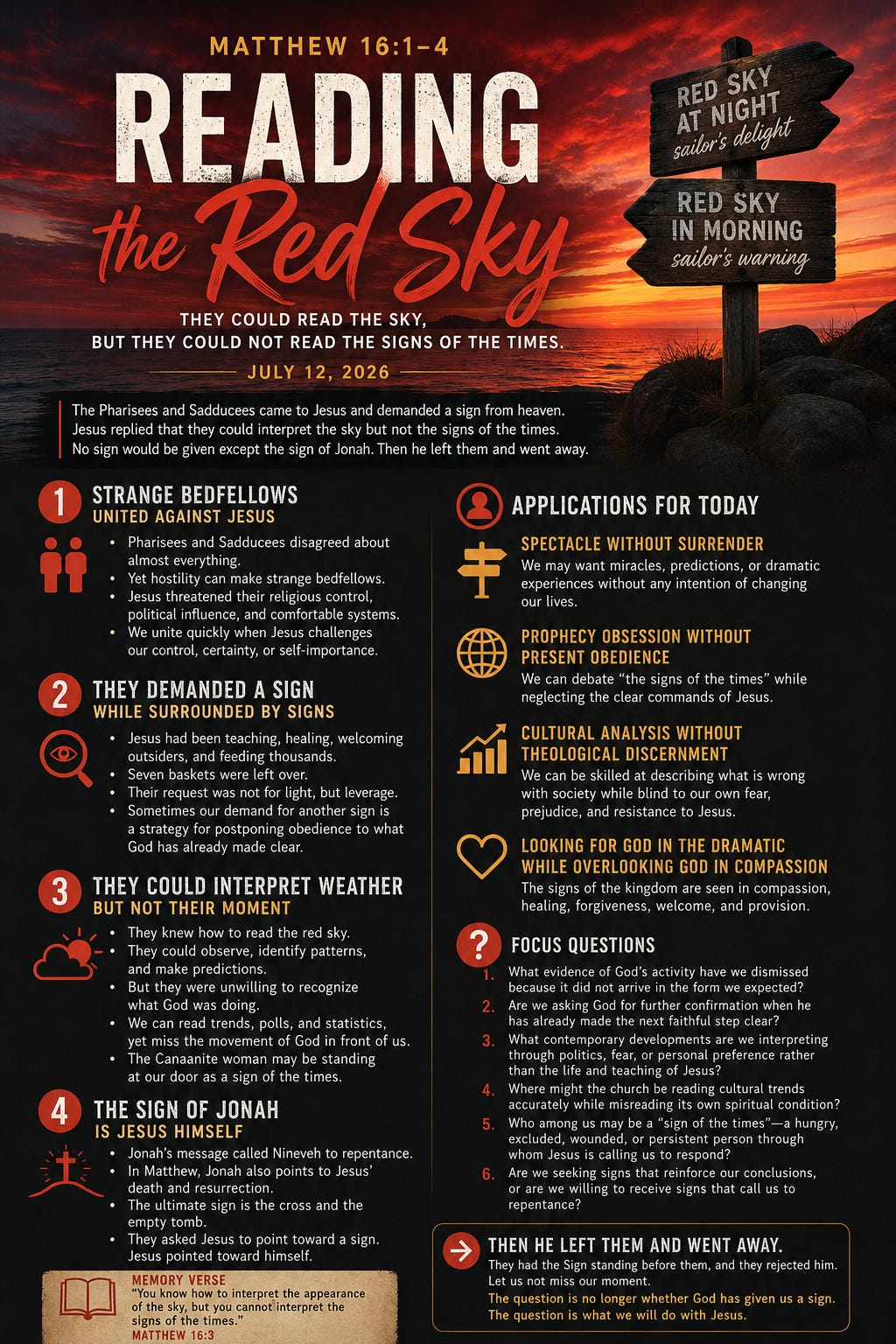
“Red sky at night, sailor’s delight. Red sky in morning, sailor’s warning.”
Many of us have heard some version of that old saying. Long before we had weather apps, satellite images, radar, and ten-day forecasts, people watched the sky.
They noticed the color of the horizon. They watched the clouds. They felt the wind. They paid attention to the moisture in the air. Farmers, fishermen, shepherds, sailors, and travelers learned to recognize patterns.
They knew that the appearance of the sky could tell them something about what was coming.
Jesus knew the saying too.
The Pharisees and Sadducees came to Jesus, and Matthew tells us that they came to test him. They asked him to show them a sign from heaven.
Jesus answered:
“When it is evening, you say, ‘It will be fair weather, for the sky is red.’ And in the morning, ‘It will be stormy today, for the sky is red and threatening.’ You know how to interpret the appearance of the sky, but you cannot interpret the signs of the times.”
They could read the red sky, but they could not read the redemptive moment.
They knew what the weather was doing, but they could not recognize what God was doing.
And that is strange because the evidence was all around them.
Jesus had been teaching with authority. He had been healing people. He had been welcoming outsiders. He had shown compassion to a Canaanite woman whom others regarded as an interruption and an annoyance.
He had fed four thousand people.
There had been bread enough and more than enough.
There were seven baskets left over.
And then the religious leaders arrived and said, “Show us a sign.”
Show us something.
Prove yourself.
Do something spectacular.
Do something undeniable.
Do something on our terms.
They were surrounded by signs, but they still demanded a sign.
Their problem was not a lack of evidence.
Their problem was their unwillingness to recognize the evidence that was already in front of them.
Strange Bedfellows
Matthew tells us that the Pharisees and Sadducees came together.
That is worth noticing.
These two groups did not agree about much.
They differed in theology. They differed in politics. They differed in their understanding of tradition. They differed about resurrection, angels, and the interpretation of Scripture.
The Pharisees were deeply invested in religious tradition and the detailed application of the law.
The Sadducees were the wealthy, politically connected aristocrats who were more willing to cooperate with Rome in order to maintain their status and influence.
They were rivals.
Yet hostility can make strange bedfellows.
People who disagree about almost everything can discover sudden unity when they find a common threat.
And Jesus was a threat.
He threatened the Pharisees’ control over religious interpretation.
He threatened the Sadducees’ comfortable relationship with political power.
He threatened every system that depended upon people remaining in their assigned places.
Jesus welcomed people who were supposed to stay outside.
He touched people others avoided.
He forgave people others condemned.
He fed people without first determining whether they deserved to be fed.
He taught that the kingdom of God belonged to the poor in spirit, the merciful, the meek, the peacemakers, and those who hunger and thirst for righteousness.
Jesus did not fit neatly into their boxes.
And we human beings do have our boxes.
We organize our ideas. We arrange our beliefs. We construct our systems. We decide what God can do, where God can work, whom God can use, and what God’s activity is supposed to look like.
Then something comes along that does not fit.
And sometimes, if it does not fit, we acquit.
We dismiss it.
We decide it cannot be true.
We call it irrelevant, dangerous, outrageous, or false.
We may not examine it. We may not listen to it. We may not allow it to challenge us.
We simply reject it because it does not fit comfortably into the world we have already constructed.
And to dismiss Jesus that way is a tragic loss of opportunity.
It is possible to know a great deal about religion and still miss God.
It is possible to quote Scripture and still resist the One to whom Scripture points.
It is possible to defend our understanding of God while refusing to recognize what God is doing right in front of us.
“Show Us a Sign”
The Pharisees and Sadducees asked Jesus for a sign from heaven.
We should distinguish their demand from the honest questions of sincere seekers.
There are people who come to God confused, wounded, uncertain, and afraid.
They say, “Lord, help me believe.”
They say, “Show me what to do.”
They say, “Give me wisdom.”
They say, “I believe; help my unbelief.”
Jesus is patient with honest seekers.
But Matthew says these leaders came to test him.
This was not a request for light. It was an attempt to gain leverage.
They wanted Jesus to perform according to their specifications.
They wanted a sign impressive enough to satisfy them but controlled enough not to change them.
They wanted evidence without surrender.
And we should be careful because it is possible for us to do the same thing.
“God, give me one more sign.”
“God, make it perfectly clear.”
“God, remove every risk.”
“God, confirm this again.”
“God, tell me what to do, but please do not tell me to do anything inconvenient.”
Sometimes our demand for another sign is a strategy for postponing obedience to what God has already made clear.
We may already know that we need to forgive someone.
We may already know that we need to make peace.
We may already know that we need to tell the truth.
We may already know that we need to stop nurturing resentment.
We may already know that we need to welcome someone we have kept at a distance.
We may already know that we need to feed somebody, encourage somebody, call somebody, apologize to somebody, or stand beside somebody.
But we say, “Lord, give me a sign.”
And perhaps the Lord says, “I have given you a command.”
Reading the Sky
Jesus did not say these religious leaders were unintelligent.
He acknowledged their powers of observation.
They knew how to interpret the sky.
They could look west in the evening, see the red glow, and anticipate fair weather.
They could see the red and threatening sky in the morning and recognize that a storm was approaching.
They knew how to gather information.
They knew how to identify patterns.
They knew how to make predictions.
They were competent when the matter affected their schedules, their crops, their travel, their safety, or their comfort.
But they could not interpret the signs of the times.
Or perhaps they would not.
There is a difference between being unable to see and being unwilling to see.
We are often perceptive about whatever affects our comfort and strangely undiscerning about whatever challenges our loyalties.
We know how to read economic reports.
We watch political polls.
We follow attendance figures.
We study cultural trends.
We analyze demographics.
We monitor social-media engagement.
We know when prices are going up, when markets are going down, when influence is shifting, and when institutions are losing ground.
We can read the red sky.
But can we read the times?
Can we recognize where compassion is needed?
Can we recognize where injustice is being normalized?
Can we recognize when fear is discipling the church more than faith?
Can we recognize when the people we call distractions may actually be divine appointments?
Can we recognize the Canaanite woman among us?
Who is she in our community?
Who is being regarded as too loud, too persistent, too needy, too foreign, too complicated, too political, too poor, too broken, or too inconvenient?
Who are the outcasts?
Who are the people we wish would go away?
Who are the people whose cries interrupt our plans?
And what if their presence is one of the signs of the times?
What if God is showing us where Jesus is going by showing us who is crying out?
What if the interruption is the invitation?
Ordinary Theologians
We are always being called to read, analyze, and reflect theologically upon our times.
That is not merely the work of professors, clergy, authors, or professional scholars.
It is the work of ordinary, everyday theologians.
And we are all theologians.
Every time we ask, “Where is God in this?” we are doing theology.
Every time we ask, “What does love require?” we are doing theology.
Every time we ask, “How does the life of Jesus help us understand this moment?” we are doing theology.
The alternative is to live in the shallow, mucky water of knee-jerkiness.
Something happens, and we immediately react.
We repeat the slogan of our preferred group.
We accept the interpretation of our favorite commentator.
We assign blame.
We become angry.
We become afraid.
We choose a side before we have asked where Jesus is standing.
Christian discernment requires more than reaction.
It requires prayer.
It requires humility.
It requires Scripture.
It requires listening.
It requires attention to the people who are suffering.
It requires the willingness to have our assumptions corrected.
The question is not merely, “What is happening?”
The question is, “What might God be calling us to do in the middle of what is happening?”
The signs of the times are not given merely to satisfy curiosity.
They call us to faithfulness.
The Sign of Jonah
Jesus said, “An evil and adulterous generation asks for a sign, but no sign will be given to it except the sign of Jonah.”
What is the sign of Jonah?
Jonah was a prophet with a message from God.
He appeared in Nineveh and announced that the people needed to turn around.
And unexpectedly, they did.
They repented.
They changed direction.
They responded to the word of God.
The sign was not merely that Jonah had experienced something extraordinary inside a great fish. The people of Nineveh knew nothing about that.
The sign to Nineveh was Jonah himself and the message he carried.
Jesus is saying, “God’s message is standing in front of you.”
In Matthew’s Gospel, the sign of Jonah also points forward.
As Jonah was delivered from the depths, Jesus would go through death and emerge in resurrection life.
The ultimate sign would not be a spectacle performed to satisfy hostile critics.
The ultimate sign would be the cross and the empty tomb.
Jesus would give his life.
Jesus would enter death.
Jesus would rise again.
They asked Jesus to point toward a sign.
Jesus pointed toward himself.
The question is not whether God has spoken.
The question is whether we will listen.
The question is not whether God has acted.
The question is whether we will recognize the action of God.
The question is not whether there is enough evidence.
The question is whether we are willing to follow the evidence wherever it leads.
Then He Left Them
Matthew closes the scene with a brief and sobering sentence:
“Then he left them and went away.”
Jesus did not remain and continue arguing.
He did not negotiate.
He did not perform for them.
He did not allow them to set the agenda.
He left.
That sentence carries weight.
They had the Sign standing in front of them, and they rejected him.
They had the Light before them, and they preferred their own conclusions.
They had the opportunity to recognize their moment, and they allowed the moment to pass.
There are divine appointments that should not be treated casually.
There are moments when truth confronts us.
There are moments when compassion calls us.
There are moments when obedience is placed before us.
There are moments when Jesus passes near.
We should not assume that every opportunity will remain open forever.
We should not spend our lives demanding that Jesus perform one more sign according to our specifications.
The sign has been given.
Jesus has come.
Jesus has spoken.
Jesus has shown compassion.
Jesus has welcomed outsiders.
Jesus has touched the unclean.
Jesus has fed the hungry.
Jesus has confronted hypocrisy.
Jesus has taken up the cross.
Jesus has risen from the dead.
We know how to read the red sky.
May God also teach us to read the redemptive moment.
May God open our eyes to what Jesus is doing.
May God deliver us from the need to have everything fit inside our comfortable boxes.
May God rescue us from the shallow water of knee-jerk reactions.
May God make us attentive, humble, courageous, and ready to obey.
The question is no longer whether God has given us a sign.
The question is what we will do with Jesus.
Join us in the subscriber section for many individual and group resources.
“Red sky at night, sailor’s delight. Red sky in morning, sailor’s warning.”
Many of us have heard some version of that old saying. Long before we had weather apps, satellite images, radar, and ten-day forecasts, people watched the sky.
They noticed the color of the horizon. They watched the clouds. They felt the wind. They paid attention to the moisture in the air. Farmers, fishermen, shepherds, sailors, and travelers learned to recognize patterns.
They knew that the appearance of the sky could tell them something about what was coming.
Jesus knew the saying too.
The Pharisees and Sadducees came to Jesus, and Matthew tells us that they came to test him. They asked him to show them a sign from heaven.
Jesus answered:
“When it is evening, you say, ‘It will be fair weather, for the sky is red.’ And in the morning, ‘It will be stormy today, for the sky is red and threatening.’ You know how to interpret the appearance of the sky, but you cannot interpret the signs of the times.”
They could read the red sky, but they could not read the redemptive moment.
They knew what the weather was doing, but they could not recognize what God was doing.
And that is strange because the evidence was all around them.
Jesus had been teaching with authority. He had been healing people. He had been welcoming outsiders. He had shown compassion to a Canaanite woman whom others regarded as an interruption and an annoyance.
He had fed four thousand people.
There had been bread enough and more than enough.
There were seven baskets left over.
And then the religious leaders arrived and said, “Show us a sign.”
Show us something.
Prove yourself.
Do something spectacular.
Do something undeniable.
Do something on our terms.
They were surrounded by signs, but they still demanded a sign.
Their problem was not a lack of evidence.
Their problem was their unwillingness to recognize the evidence that was already in front of them.
Strange Bedfellows
Matthew tells us that the Pharisees and Sadducees came together.
That is worth noticing.
These two groups did not agree about much.
They differed in theology. They differed in politics. They differed in their understanding of tradition. They differed about resurrection, angels, and the interpretation of Scripture.
The Pharisees were deeply invested in religious tradition and the detailed application of the law.
The Sadducees were the wealthy, politically connected aristocrats who were more willing to cooperate with Rome in order to maintain their status and influence.
They were rivals.
Yet hostility can make strange bedfellows.
People who disagree about almost everything can discover sudden unity when they find a common threat.
And Jesus was a threat.
He threatened the Pharisees’ control over religious interpretation.
He threatened the Sadducees’ comfortable relationship with political power.
He threatened every system that depended upon people remaining in their assigned places.
Jesus welcomed people who were supposed to stay outside.
He touched people others avoided.
He forgave people others condemned.
He fed people without first determining whether they deserved to be fed.
He taught that the kingdom of God belonged to the poor in spirit, the merciful, the meek, the peacemakers, and those who hunger and thirst for righteousness.
Jesus did not fit neatly into their boxes.
And we human beings do have our boxes.
We organize our ideas. We arrange our beliefs. We construct our systems. We decide what God can do, where God can work, whom God can use, and what God’s activity is supposed to look like.
Then something comes along that does not fit.
And sometimes, if it does not fit, we acquit.
We dismiss it.
We decide it cannot be true.
We call it irrelevant, dangerous, outrageous, or false.
We may not examine it. We may not listen to it. We may not allow it to challenge us.
We simply reject it because it does not fit comfortably into the world we have already constructed.
And to dismiss Jesus that way is a tragic loss of opportunity.
It is possible to know a great deal about religion and still miss God.
It is possible to quote Scripture and still resist the One to whom Scripture points.
It is possible to defend our understanding of God while refusing to recognize what God is doing right in front of us.
“Show Us a Sign”
The Pharisees and Sadducees asked Jesus for a sign from heaven.
We should distinguish their demand from the honest questions of sincere seekers.
There are people who come to God confused, wounded, uncertain, and afraid.
They say, “Lord, help me believe.”
They say, “Show me what to do.”
They say, “Give me wisdom.”
They say, “I believe; help my unbelief.”
Jesus is patient with honest seekers.
But Matthew says these leaders came to test him.
This was not a request for light. It was an attempt to gain leverage.
They wanted Jesus to perform according to their specifications.
They wanted a sign impressive enough to satisfy them but controlled enough not to change them.
They wanted evidence without surrender.
And we should be careful because it is possible for us to do the same thing.
“God, give me one more sign.”
“God, make it perfectly clear.”
“God, remove every risk.”
“God, confirm this again.”
“God, tell me what to do, but please do not tell me to do anything inconvenient.”
Sometimes our demand for another sign is a strategy for postponing obedience to what God has already made clear.
We may already know that we need to forgive someone.
We may already know that we need to make peace.
We may already know that we need to tell the truth.
We may already know that we need to stop nurturing resentment.
We may already know that we need to welcome someone we have kept at a distance.
We may already know that we need to feed somebody, encourage somebody, call somebody, apologize to somebody, or stand beside somebody.
But we say, “Lord, give me a sign.”
And perhaps the Lord says, “I have given you a command.”
Reading the Sky
Jesus did not say these religious leaders were unintelligent.
He acknowledged their powers of observation.
They knew how to interpret the sky.
They could look west in the evening, see the red glow, and anticipate fair weather.
They could see the red and threatening sky in the morning and recognize that a storm was approaching.
They knew how to gather information.
They knew how to identify patterns.
They knew how to make predictions.
They were competent when the matter affected their schedules, their crops, their travel, their safety, or their comfort.
But they could not interpret the signs of the times.
Or perhaps they would not.
There is a difference between being unable to see and being unwilling to see.
We are often perceptive about whatever affects our comfort and strangely undiscerning about whatever challenges our loyalties.
We know how to read economic reports.
We watch political polls.
We follow attendance figures.
We study cultural trends.
We analyze demographics.
We monitor social-media engagement.
We know when prices are going up, when markets are going down, when influence is shifting, and when institutions are losing ground.
We can read the red sky.
But can we read the times?
Can we recognize where compassion is needed?
Can we recognize where injustice is being normalized?
Can we recognize when fear is discipling the church more than faith?
Can we recognize when the people we call distractions may actually be divine appointments?
Can we recognize the Canaanite woman among us?
Who is she in our community?
Who is being regarded as too loud, too persistent, too needy, too foreign, too complicated, too political, too poor, too broken, or too inconvenient?
Who are the outcasts?
Who are the people we wish would go away?
Who are the people whose cries interrupt our plans?
And what if their presence is one of the signs of the times?
What if God is showing us where Jesus is going by showing us who is crying out?
What if the interruption is the invitation?
Ordinary Theologians
We are always being called to read, analyze, and reflect theologically upon our times.
That is not merely the work of professors, clergy, authors, or professional scholars.
It is the work of ordinary, everyday theologians.
And we are all theologians.
Every time we ask, “Where is God in this?” we are doing theology.
Every time we ask, “What does love require?” we are doing theology.
Every time we ask, “How does the life of Jesus help us understand this moment?” we are doing theology.
The alternative is to live in the shallow, mucky water of knee-jerkiness.
Something happens, and we immediately react.
We repeat the slogan of our preferred group.
We accept the interpretation of our favorite commentator.
We assign blame.
We become angry.
We become afraid.
We choose a side before we have asked where Jesus is standing.
Christian discernment requires more than reaction.
It requires prayer.
It requires humility.
It requires Scripture.
It requires listening.
It requires attention to the people who are suffering.
It requires the willingness to have our assumptions corrected.
The question is not merely, “What is happening?”
The question is, “What might God be calling us to do in the middle of what is happening?”
The signs of the times are not given merely to satisfy curiosity.
They call us to faithfulness.
The Sign of Jonah
Jesus said, “An evil and adulterous generation asks for a sign, but no sign will be given to it except the sign of Jonah.”
What is the sign of Jonah?
Jonah was a prophet with a message from God.
He appeared in Nineveh and announced that the people needed to turn around.
And unexpectedly, they did.
They repented.
They changed direction.
They responded to the word of God.
The sign was not merely that Jonah had experienced something extraordinary inside a great fish. The people of Nineveh knew nothing about that.
The sign to Nineveh was Jonah himself and the message he carried.
Jesus is saying, “God’s message is standing in front of you.”
In Matthew’s Gospel, the sign of Jonah also points forward.
As Jonah was delivered from the depths, Jesus would go through death and emerge in resurrection life.
The ultimate sign would not be a spectacle performed to satisfy hostile critics.
The ultimate sign would be the cross and the empty tomb.
Jesus would give his life.
Jesus would enter death.
Jesus would rise again.
They asked Jesus to point toward a sign.
Jesus pointed toward himself.
The question is not whether God has spoken.
The question is whether we will listen.
The question is not whether God has acted.
The question is whether we will recognize the action of God.
The question is not whether there is enough evidence.
The question is whether we are willing to follow the evidence wherever it leads.
Then He Left Them
Matthew closes the scene with a brief and sobering sentence:
“Then he left them and went away.”
Jesus did not remain and continue arguing.
He did not negotiate.
He did not perform for them.
He did not allow them to set the agenda.
He left.
That sentence carries weight.
They had the Sign standing in front of them, and they rejected him.
They had the Light before them, and they preferred their own conclusions.
They had the opportunity to recognize their moment, and they allowed the moment to pass.
There are divine appointments that should not be treated casually.
There are moments when truth confronts us.
There are moments when compassion calls us.
There are moments when obedience is placed before us.
There are moments when Jesus passes near.
We should not assume that every opportunity will remain open forever.
We should not spend our lives demanding that Jesus perform one more sign according to our specifications.
The sign has been given.
Jesus has come.
Jesus has spoken.
Jesus has shown compassion.
Jesus has welcomed outsiders.
Jesus has touched the unclean.
Jesus has fed the hungry.
Jesus has confronted hypocrisy.
Jesus has taken up the cross.
Jesus has risen from the dead.
We know how to read the red sky.
May God also teach us to read the redemptive moment.
May God open our eyes to what Jesus is doing.
May God deliver us from the need to have everything fit inside our comfortable boxes.
May God rescue us from the shallow water of knee-jerk reactions.
May God make us attentive, humble, courageous, and ready to obey.
The question is no longer whether God has given us a sign.
The question is what we will do with Jesus.
Join us in the subscriber section for many individual and group resources.
Beyond the Sign: Learning to Discern and Respond
The Pharisees and Sadducees could read the sky, but they could not read the moment.
That warning is not preserved merely so that we can criticize ancient religious leaders. It invites us to examine our own habits of seeing, interpreting, and responding.
We live in a time of constant information. We receive alerts, forecasts, polls, predictions, trends, commentary, and analysis throughout the day. We are often very skilled at identifying what is changing around us.
But Christian discernment asks a deeper set of questions:
Where is God at work?
Where is compassion calling?
Who is being overlooked?
What truth are we resisting?
What act of obedience have we been postponing while asking for one more sign?
The exercises below are intended for individual reflection, small groups, Sunday school classes, ministry teams, and congregational leaders.
1. Reading the Moment
Begin by naming what you see happening around you.
Consider your:
family,
church,
neighborhood,
workplace,
city,
nation,
and wider world.
Complete these sentences:
One change I am noticing is:
One source of anxiety or confusion in my community is:
One group of people who may be overlooked, dismissed, or unheard is:
One place where I see compassion, courage, truth, or reconciliation emerging is:
Now move beyond observation.
Ask:
What might this moment be revealing?
What assumptions are being challenged?
Where might Jesus already be present?
What response would be consistent with his life and teaching?
Discernment is not merely the ability to describe what is happening.
Discernment asks what faithfulness requires in the middle of what is happening.
2. Signs We May Be Missing
The religious leaders asked Jesus for a sign while signs of the kingdom surrounded them.
People were being healed.
Outsiders were being welcomed.
Hungry people were being fed.
A persistent woman was being heard.
Compassion was crossing boundaries.
The signs were present, but they did not match the leaders’ expectations.
Reflect upon these questions:
Where have I expected God to work dramatically while overlooking quiet acts of faithfulness?
Have I dismissed something because it did not fit my theological, political, cultural, or personal expectations?
Who has challenged one of my comfortable categories?
Where might God be working through people I would not normally recognize as messengers?
What evidence of grace have I overlooked because I was concentrating on what was wrong?
Write down one sign of grace you have recently witnessed:
Now ask:
What would it mean for me to join that work rather than merely admire it?
3. When Asking for a Sign Becomes Avoidance
There is nothing wrong with asking God for wisdom.
Scripture encourages us to pray, seek counsel, test our motives, and proceed carefully.
But sometimes we ask for more guidance because we do not want to act upon the guidance we have already received.
Complete the following statements honestly:
I keep asking God for clarity about:
Deep down, I may already know that I need to:
The risk or discomfort I am trying to avoid is:
The next faithful step may be:
That next step does not have to be dramatic.
It may be:
making a telephone call,
offering an apology,
telling the truth,
ending a harmful habit,
listening before speaking,
welcoming someone,
sharing food,
visiting a lonely person,
defending someone being mistreated,
asking forgiveness,
or beginning a conversation you have postponed.
We do not always need a new sign to obey an old command.
4. Identifying the Canaanite Woman Among Us
The events immediately preceding this passage matter.
Jesus had encountered a Canaanite woman whose cries made the disciples uncomfortable. They wanted her sent away.
She was persistent.
She was an outsider.
She did not fit comfortably within their understanding of the mission.
Yet Jesus received her, commended her faith, and answered her plea.
Then Jesus fed a large crowd, leaving seven baskets of food behind.
These events help us understand the signs the religious leaders were missing. God’s kingdom was appearing in compassion toward people who were easily dismissed.
Ask together:
Who is treated as an interruption in our church?
Whose needs make us uncomfortable?
Who is expected to remain quiet?
Who is present but not fully included?
Who has stopped coming because they did not feel heard?
Which people in our community are discussed more often than they are consulted?
Are there people we identify primarily as problems rather than neighbors?
Create a list of people or groups in your community who may experience exclusion:
Now choose one.
Ask:
What would listening look like?
What would welcome look like?
What would practical compassion look like?
What might we learn from them?
The goal is not to design a program for people without them.
The first step may simply be to listen.
5. Escaping Knee-Jerkiness
We often react to events before we have reflected upon them.
We repeat the conclusions of our preferred group.
We adopt the language of our favorite commentator.
We assign blame.
We become angry.
We become afraid.
We choose a side before asking where Jesus is standing.
Use this five-part practice when facing a difficult issue.
Pause
What emotional reaction am I experiencing?
Listen
Whose voice have I not yet heard?
Examine
What assumptions, loyalties, fears, or prejudices may be shaping my interpretation?
Look to Jesus
What do the character, teaching, compassion, death, and resurrection of Jesus reveal about this issue?
Respond
What action would be truthful, loving, just, humble, and faithful?
This process will not remove every disagreement.
It may, however, keep us from living in the shallow, mucky water of knee-jerkiness.
6. Reading the Times as a Church
Churches can become highly skilled at reading statistics while remaining spiritually undiscerning.
We can track:
attendance,
giving,
online engagement,
demographic changes,
building use,
volunteer participation,
and program effectiveness.
These measurements can be useful.
But they cannot answer every important question.
A ministry team or leadership group might discuss:
Where do we see hunger—physical, emotional, relational, or spiritual—in our community?
Who is approaching us but not being heard?
Which ministries are producing compassion, healing, welcome, and reconciliation?
Where are we protecting an institution rather than advancing the mission of Jesus?
What are we afraid of losing?
Where might fear be shaping our decisions more than faith?
What inherited practice may need to be reconsidered?
What opportunity is before us now that may not remain open forever?
Are we waiting for perfect certainty before taking a faithful step?
What can we do within the next thirty days?
Choose one concrete action:
Assign responsibility:
Set a date:
Determine how you will listen to the people most affected:
7. The Sign of Jonah
Jesus said that no sign would be given except the sign of Jonah.
Jonah arrived in Nineveh carrying a call to repentance.
The people changed direction.
In Matthew’s Gospel, the sign of Jonah also points toward the death and resurrection of Jesus.
The cross reveals the depth of divine love.
The resurrection announces that death, oppression, hatred, and despair do not have the final word.
Therefore, Christian discernment is never merely an exercise in predicting what will happen.
It is an invitation to repent, believe, and participate in resurrection life.
Ask:
What needs to die in me?
What resentment needs to be surrendered?
What false loyalty needs to be released?
What prejudice needs to be confronted?
What habit needs to end?
What act of courage needs to begin?
What new life may God be bringing forth?
Complete this prayer:
Lord Jesus, I need to turn away from:
I need to turn toward:
8. A Seven-Day Practice of Discernment
For the next seven days, begin each morning with this prayer:
Lord Jesus, open my eyes to the signs of your kingdom.
Show me where compassion is needed.
Show me whom I am tempted to overlook.
Show me what truth I am resisting.
Show me the next faithful step.
Give me courage to follow you.
At the end of each day, record:
Where did I see grace today?
Who needed to be heard?
What challenged one of my assumptions?
What act of obedience became clear?
How will I respond tomorrow?
Group Discussion Questions
Why do you think the Pharisees and Sadducees demanded a sign after so many signs had already been given?
What is the difference between an honest search for guidance and a demand for proof?
Why are people sometimes better at interpreting external events than examining their own spiritual condition?
What kinds of signs tend to impress the contemporary church?
What signs of God’s kingdom may receive less attention?
How can political, theological, or institutional loyalty make us spiritually blind?
Who might be the Canaanite woman in our community?
Where are hungry people being fed, outsiders being welcomed, or wounded people being restored?
What clear teaching of Jesus are we tempted to postpone while seeking further confirmation?
What is one faithful action our group can take this week?
Closing Reflection
They could read the red sky, but they could not read the redemptive moment.
May we not make the same mistake.
May we recognize Jesus in the person who cries out.
May we see the kingdom in acts of compassion.
May we listen when truth challenges our comfortable boxes.
May we become more interested in obedience than spectacle.
May we become ordinary, everyday theologians who ask not only what is happening, but what faithfulness requires.
The sign has been given.
Jesus has come.
Jesus has spoken.
Jesus has shown us the way of compassion, truth, sacrifice, and resurrection.
The question is not whether God has given us a sign.
The question is what we will do with Jesus.
Closing Prayer
Lord Jesus,
We are often skilled at reading the world around us but slow to recognize what you are doing.
Forgive us for demanding signs while ignoring your clear commands.
Forgive us for protecting our comfort, defending our categories, and dismissing people who interrupt our plans.
Open our eyes to the signs of your kingdom.
Teach us to recognize compassion, truth, mercy, justice, reconciliation, and new life.
Help us hear the cries of those we have overlooked.
Deliver us from fear, prejudice, pride, and knee-jerk reactions.
Give us wisdom to interpret the times and courage to take the next faithful step.
You are the sign.
You are the message.
You are the crucified and risen Lord.
Teach us to recognize you, trust you, and follow you.
Amen.


